
OH dangit, Period is here. Again. Ugh. 🤬😖🤢😣😴
Dear Period,
Through my adolescent years and into my twenties, then early years of marriage, you and your inseparable PMS Wingwoman were a pesky combo that plagued me every 24 days, bleeding me for 7 days each time.
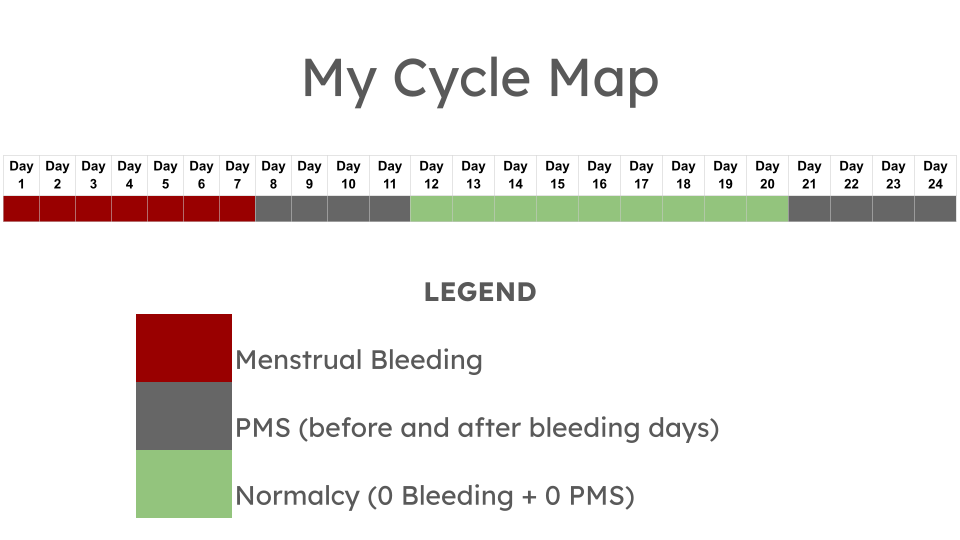
The 24-Day Hijack
This short cycle meant that we met for 15 cycles annually—bleeding 106 days (or 3.5 months) per year. Other people’s Periods visited them every 28 days—bleeding 91 days (about 3 months) per year.
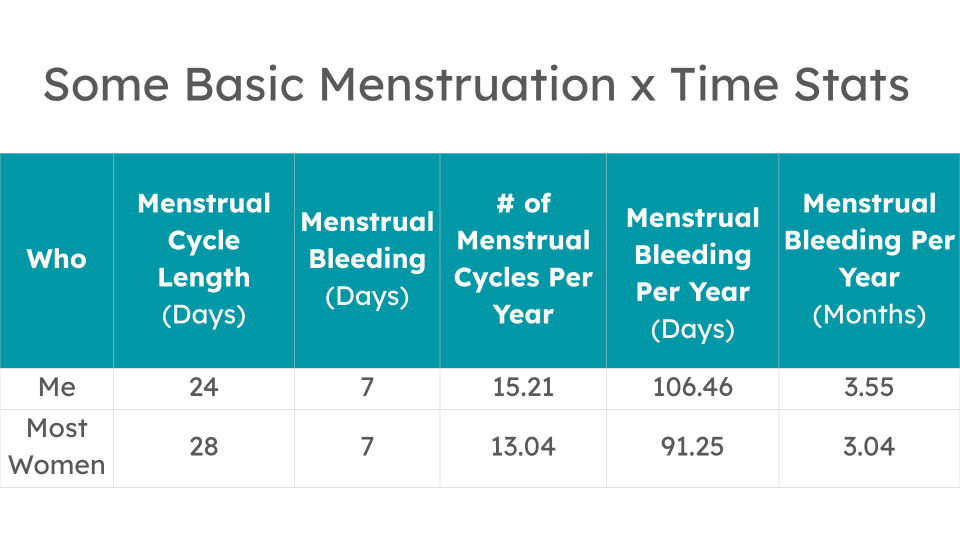
I did some calculations. You hijacked a very significant proportion of time in my life. Of the 38 years we were acquainted, we bled for 135 months (11 years).
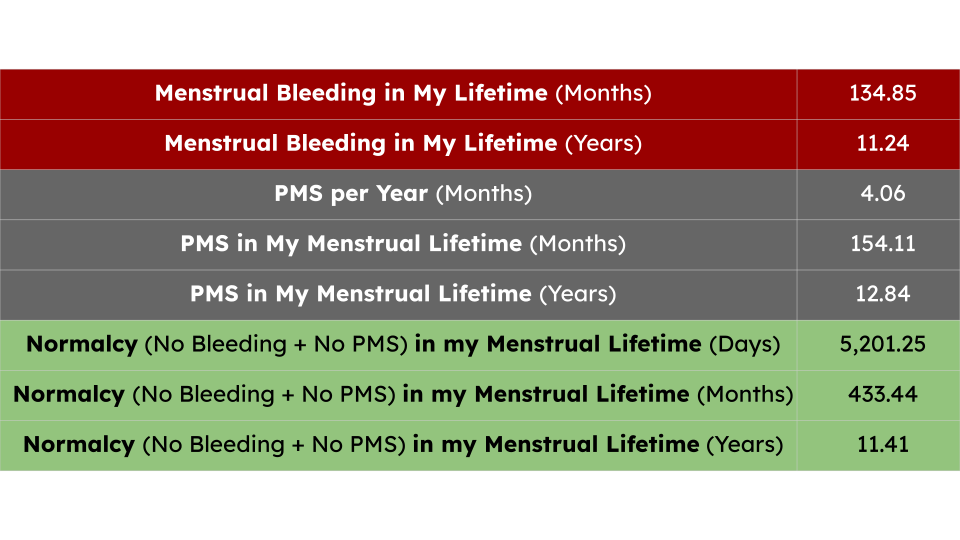
11 years. That is more than a decade of my life spent actively bleeding.
Why did you visit so often? Why so needy?
Given my 3-week cycle and the PMS tenacity, I only felt fully “normal” for a measly 9 days out of every 24-day cycle. That’s 137 days of normalcy out of 365 days in a year.
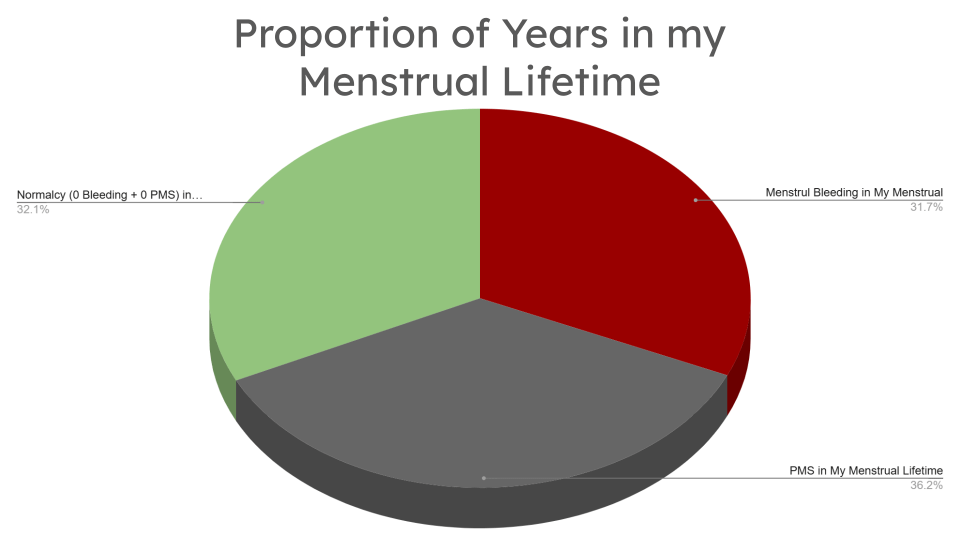
433 months (11.4 years, 32.1%) of normalcy, over the 38 years of our relationship. Which means that out of my entire menstrual lifetime of 38-years, I spent 25.8 years—or 67.9% of that time—trying to function while actively compromised by bleeding and PMS.
To think that 50% of the global population functions while quietly experiencing a similar private hell for at least 50% of their menstrual lifetime is mind-boggling. If this were a condition that MEN had to endure, there would be monthly paid leave for Menstrual Wellness. Menstruation products would be covered by universal healthcare, health insurance, or qualify for income tax credit. Or simply readily available for FREE; to anyone, anywhere, at all times—so that nobody would have to carry that stuff with them everywhere they go—because who needs that inconvenience and financial burden? The condition itself would be publicly elevated to physical- and character-building Menstrual Martyrdom Mission Quest. And men would be exalted as Everyday Heroes for showing such forbearance and resilience in the face of Nature-imposed regularly-scheduled torture.
Given that suffering and adverse life experiences have been correlated with the development of empathy, compassion, and prosocial behavior (Lim & DeSteno, 2016), it’s not surprising that women demonstrate higher levels of empathy than men, and that these sex differences in empathy levels grow larger with age (Christov-Moore, Simpson, Coudé, Grigaityte, Iacobani, Ferrari, 2016). However, that same study failed to take into account every woman’s private SUFFERING and regularly humbling HELL, that she must quietly find a way to cope with as she journeys through life. For me, that coping mechanism started out as an involuntary, brutal physical boot camp.
The Training Regimen
The VERY WORST thing about you was the severe period cramping (dysmenorrhea)—like sharp and repetitive abdominal stabbing that made me double over and immobilized me into fetal position. Mental visions of my uterus spasming with intention, sloughing off its unused lining like a superhero cape. The deep red cape exiting the vaginal canal in dark red globular chunks and stretchy sanguine syrup.
So intense was the pain, that there were times you caused sudden cold sweating and spotty vision, putting me on the verge of fainting. WHYYYYY was any of this necessary? By the time I was 13, I learned to sit with my head between my knees as soon as the cold sweats came, to prevent myself from fainting. Over-the-counter painkillers sometimes helped, but seemed to exacerbate the heavy lethargy that always came with the pain—a mixed blessing.
I later learned that the pain level of severe period cramping is equivalent to early-stage labour and heart attack.
So is THAT it? Years of intermittent and torturous period cramping as a TRAINING REGIMEN for eventual childbirth, years later?

Your PMS Wingwoman was always too generous with her terrible taste in gifts:
Period acne and bloating
Headaches and breast tenderness
Irritability, sadness, and mood swings
Anxiety and fatigue
These unwanted gifts had such staying power, lingering for days after tail end spotting ceased.
For a neurodivergent child born with big feelings, the emotional chaos and acne shame were amplified and felt even more acutely. Sensory overload during PMS was particularly grating and challenging to navigate, but also forced me to start learning early how to self-regulate under such challenges.

I couldn’t decide if you, Period, were a TRAITOROUS part of my body that lay dormant some of the time and aggressively asserted your presence other times, or if you were an external ENEMY that visited from time to time.

But by the time I was 12, I decided you were most definitely an external ENEMY whose torturous visits I had no choice but to accept with as much grace as I could manage. The possibility that my body would ever betray me was just too frightening for my 12-year-old mind to accept.
The Cognitive Load of Period Logistics

Your frequent visits, Period, didn’t just disrupt my body; you constantly threatened my experience of Life. Navigating a rigorous academic schedule, high-stakes exams, and later, a demanding professional career meant I was trapped in a perpetual state of defensive logistics.
It was an extra cognitive load that I did NOT need.
If an important final exam, a cross-country/track meet, cheerleading competition, or a crucial presentation fell during my 7 days of abdominal stabbing and PMS brain fog, “taking a sick day” wasn’t an option. I had to learn how to mask the pain and perform through the exhaustion.
Mitigating your impact became a military-style operation. It meant:
Pre-emptively dosing myself with painkillers hours before a test, praying the timing would align so the sharpest cramps wouldn’t hit mid-exam.
Mapping out the nearest restrooms at every new venue or office space to ensure a quick escape route for sudden cold sweats.
Planning outfits with comfortable dark bottoms, loose tops, and flat shoes for those bloaty bleeding days.
Carrying Tylenol/Advil plus an arsenal of different sized pads and tampons at all times.
Channeling every ounce of my neurodivergent masking energy just to sit upright and look professional while my uterus was staging a violent coup.
It was an exhausting, invisible layer of project management that coincided with every major milestone of my youth and early career. I couldn’t afford to be passive. To survive the school year and later, the workplace, I had no choice but to master the art of defensive scheduling. Quite the operation, given my innate time-blindness.
The Data, the Dialogue, and the Soup
Your comings and goings made it imperative for me to learn how to notice and make meaning of the data my body was regularly giving to me. The annoying and oftentimes embarrassing period-related questions my mother would ask every cycle, coupled with the calendar tracking she insisted I keep up with, cultivated in me from a young age a holistic approach to interpreting individual symptom “data points” as patterned holistic systems—a way of thinking that has expanded to many other parts of my life as I journey on.
“You seem pale and tired. Is Period time coming?”
“I’m not pale and tired. Can you stop with the Period questions?”
“Aiya 哎呀! Now you’re mung zaang (忟憎 irritable)! It’s PMS time then. Are you bloated?”
“It’s MY body! Why do your questions sound so bossy and certain about MY body? Can’t you just leave me alone?”
“Leave you alone? LEAVE YOU ALONE, AH? I only WISH my OWN mother, your PoPo, cared this much about MY cycle when I was your age! How am I supposed to know which tong (湯 soup) to make for you if I don’t know which part of your cycle you are in?”
“Then don’t bo tong (煲湯 make soup) for me! None of my friends’ moms bug them about their Periods!”
“Your friends don’t have Chinese mothers who make tong for their good health! Too bad for them! You’re too dumb to see your own luck!”
“I’m NOT dumb!”
“Aiya! Saang go cha siu bao hou gwo saang neh!” (哎呀! 生個义燒飽好過生你 It’s better to have given birth to a BBQ pork bun than to have given birth to you) — a common colourful Cantonese colloquialism popular among exasperated mothers. Adolescents know they’ve levelled up their teenage rebelliousness when they can coax this phrase out of their mothers.
SIDENOTE: ‘Aiya’ 哎呀 is a versatile, everyday interjection used to express surprise, disappointment, frustration, dismay, or pain—depending on the context. Kinda like saying “Oh no!,” “Oops!,” “Ouch!” in English. You’ll likely be seeing Aiya 哎呀 in my posts a LOT.

On and on it would spiral and escalate. This regular line of questioning felt embarrassing, intrusive, and suffocating. It made me feel powerless and angry—further animating you, Period, into a larger and larger ENEMY. But despite my tactical attempts to evade my mother’s annoying Period interrogations; her fiery, loving, and determined persistence would eventually wear me down and I’d sulkily take the time to notice what my body was telling me, and reluctantly tell her about it. We’d argue about discuss what the symptoms meant, what ingredients she planned to use, and why. The older I got, the more I appreciated these conversations with my mother and the wisdom she was sharing with me.
You would think that after a while, the ingredients discussion would become repetitive, but no. Because she was in regular contact with her friends—whom I affectionately think of as her “TaiTai 太太 Network” of Chinese Canadian housewives, where the art and science of bo tong was, and continues to be, a regular topic of enthusiastic conversation.
The Art and Science of Bo Tong (煲湯 Soup-Making)

Mom’s TaiTai friends were a fiercely formidable group of ladies and a veritable Knowledge Community of all things Cantonese Chinese. We all lived in the same neighbourhood and they first met while walking their kids to school in the mornings, then they’d head to someone’s home (often ours) for tea and snacks, and the magic that happens when women come together to gab about life. Navigating Womanhood and Motherhood as first-generation Chinese-Canadians in a land they were not born to, but which they had chosen for their forever home, was a common theme. Much time and energy was also spent swapping bo tong (煲湯 soup-making) wisdom that was handed down to each of them through their ancestral ladder of matriarchs; or gathered through their friend and family networks, random conversations with TCM doctors, TV and radio interviews of TCM doctors and home cooks, and local Chinese newspaper columns about health written by TCM doctors. Bo tong knowledge has always been ever-evolving among generations of Chinese mothers and grandmothers since time immemorial.
I don’t know if mom’s soups truly made a difference in my cycles, but her tong has always warmed my body and soul. All the thoughtful care she puts into them is pure liquid love. To this day, now in her early 80s, she still makes nourishing and delicious tong for my husband and me on a weekly basis, and we are so very grateful.
For those who didn’t grow up with a Chinese mother exclaiming ‘Aiya!’ from various places in the home and at all hours of the day, bo tong (煲湯 soup-making) is a very important part of inter-generational wisdom, family life, and health. Slow-simmered broths represent intergenerational love, family connection, and the ancient wisdom of Traditional Chinese Medicine (TCM) that has developed over thousands of years—where food acts as medicine to strengthen, heal, nourish, balance, or restore the body’s internal energy.
Every ingredient has a purpose. Ingredients such as goji berries, ginseng, astragalus root, and lotus root are not chosen for flavor alone. They are combined using generations of recorded botanical and culinary knowledge to strengthen qi (氣 life force energy) and nourish the blood.
Which soup to make depends entirely on the season, the current weather, who will be drinking it, and what their current physical, temperament, digestive, sleep, and energy levels are at. Soups often contain a mixture of medicinal herbs alongside standard whole foods. Tong is particularly important for women during pregnancy and the traditional 30-day post-partum confinement*.
To learn more about types of soups and how-to’s, check out The Chinese Soup Ladies. If you’re able to read Chinese, Dr. Arthur Lo TCM has written a book about nourishing soups to boost immunity.
Traditionally, tong is a health ritual enjoyed by the family, daily. But in the daily hustle of modern times, tong as a weekly ritual is more realistically manageable. Some members of the Chinese diaspora have modernized tong to an entrepreneurial direction—offering bo tong wisdom as well as proportioned soup packages of dried ingredients to make at home, or ready-made soups, or both:
Philip Herbal Shop (孔大吉參藥鋪) at First Markham Place, Pacific Mall, and Langham Square (Markham, Ontario)
https://www.souperwell.com (Toronto GTA)
https://yumtongcyuen.com (Vancouver)
https://www.tangtangclub.com (Singapore)
*SIDENOTE—30-day post-partum confinement: I know this sounds like an antiquated misogynistic tool of the Patriarchy for their oppressive pleasure. I assure you it is not. It is a nourishing period of deep rest and recovery following childbirth. The new mother’s mother, mother-in-law, aunties, or even hired aunties for this period, lavish the new mom with nourishing food and tong. This time of rest and seclusion focuses on keeping the body warm, eating nutrient-dense foods, and delegating household chores to allow the new mother to heal completely and to bond with her child.
Matriarchs, Menstruation, and Mother-Love

The regular Period interrogations discussions with my mother in my pre-teen years quickly destigmatized you, Period, in my mind. By the time I was in high school, I had downgraded you from Nuclear-Level ENEMY to Unwanted GUEST. Strangely, you were also a conduit to intensifying my fiery relationship with my mother in my teenage years. Period conversations that were about as comfortable as petting a porcupine have that effect.
Decades later, the Enemy has been downgraded, the porcupine has been petted, and the Annoying Intruder has finally left for good. But the tong? The tong stays. And so does the data-driven, liquid love my mother boiled into my bones and soul.
JiaHui 家慧
Disclaimer: I have no financial ties to any of the vendors mentioned in this post. No sponsorships, no payouts, no perks—just pure resource-sharing.
💬 Let’s Chat!
I’d love to hear how these themes ripple into your own lives. I invite you to pick a question (or two) and share your thoughts in the comments below:
Reclaiming the “Enemy”: Did you grow up viewing your period as an external adversary, a physical betrayal, or a chronic intruder to be endured? How has your relationship with your cycles evolved as you’ve transitioned through different phases of your life?
The Sensory & Emotional Reality: For those who navigate menstruation with neurodivergence or simply with “big feelings,” how did you cope with the amplified emotional chaos, pain, or sensory overload of PMS? What did your body force you to learn about self-regulation early on?
The Logistical Gymnastics: How did your period symptoms impact your school days, high-stakes exams, early career, or life events? What kind of “invisible project management” or masking did you have to perform to ensure your symptoms didn’t derail your functioning/performance?
Tracking Your Data: My mother’s persistent interrogations forced me to connect the individual “data points” of my cycle into a holistic system—a tracking habit I kept up for my 38-year menstruating life. Do you track your cycle data today? How has paying close attention to your body’s patterns changed how you manage your health, mood, or energy levels?
Matriarchal Intervention: Whether it was a Chinese mother insisting on bo tong (煲湯 soup-making) or an elder in your own culture, how did the women in your life react to your period? Did their care feel like an intrusive interrogation, “liquid love,” or a comforting ritual you only appreciated much later?
Passing Down the Wisdom: How are you changing the narrative around menstruation for yourself or the younger generation in your life? How do we move from treating our periods like an embarrassing secret to honouring them as a vital source of personal data and legacy?